 ACQUISITION SERVICES SUPPLIER OF THE YEAR

Who is actually buying estate and lettings agencies right now?
It is one of the first questions owners ask when they begin thinking about a sale: “Who do you think would buy my business?”
For most sellers, the answer matters for more than financial reasons.
They want to understand who may be interested, what that buyer will value and what a sale could mean for the team, the brand and the clients they have spent years looking after.
At Atomic Consultancy, our work with buyers and sellers gives us a close view of how the market is changing.
Our latest data shows that independent buyers remain the largest group, equity-funded buyers are becoming far more active, corporate buyers appear to be more selective and franchised buyers continue to play a steady role.
For agency owners, that matters. Understanding the buyer landscape can help you position your business more effectively and prepare for the questions a serious buyer is likely to ask.
Whether you are considering a sale now or starting to plan a few years ahead, the figures offer a useful view of what is happening behind the scenes.
Understanding the Main Buyer Types
The buyer market can feel difficult to read from the outside.
One sale may involve a national group, another a neighbouring independent and another an investment-backed business looking to build scale.
For this research, Atomic Consultancy has grouped buyers into four broad categories:
- Independent Buyers
- Corporate Buyers
- Franchised Buyers
- Equity-Funded Buyers
Each group has different motivations. Some want local expansion, some are focused on recurring lettings income and others are looking for agencies that can become part of a wider platform.
For sellers, the right buyer is not necessarily the one with the biggest name.
It is the buyer with the right appetite, funding and plans for the business after completion.
“Agency owners often assume there will be one obvious type of buyer for their business, but that is rarely the case. The buyer market is much more varied than many sellers realise, and understanding that landscape early can make a real difference to how a business is prepared and positioned for sale.”
Lucy Noonan, Founder of Atomic Consultancy
Independent Buyers
Independent buyers include existing agency owners, local competitors, regional operators and private investors.
They are often hands-on and commercially practical, with a strong understanding of how an agency works day to day, for sellers who care about continuity, staff and local reputation, which can make them a particularly good fit.
Corporate Buyers
Corporate buyers are larger regional or national organisations with established acquisition criteria and approval processes.
They can be strong acquirers, but they often become more selective when market conditions or internal priorities change.
Franchised Buyers
Franchised buyers are independently owned businesses operating under a wider brand or network.
They are often looking to strengthen a defined territory or expand into a neighbouring location, offering sellers a combination of local ownership and broader brand support.
Equity-Funded Buyers
Equity-funded buyers are backed by private equity, investor groups or other structured funding.
They are often focused on growth through acquisition and may move quickly when a business offers strong recurring income, clear systems and reliable management information.
What Atomic’s Buyer Data Shows
Atomic Consultancy’s latest figures show a clear change in where buyer activity is coming from.
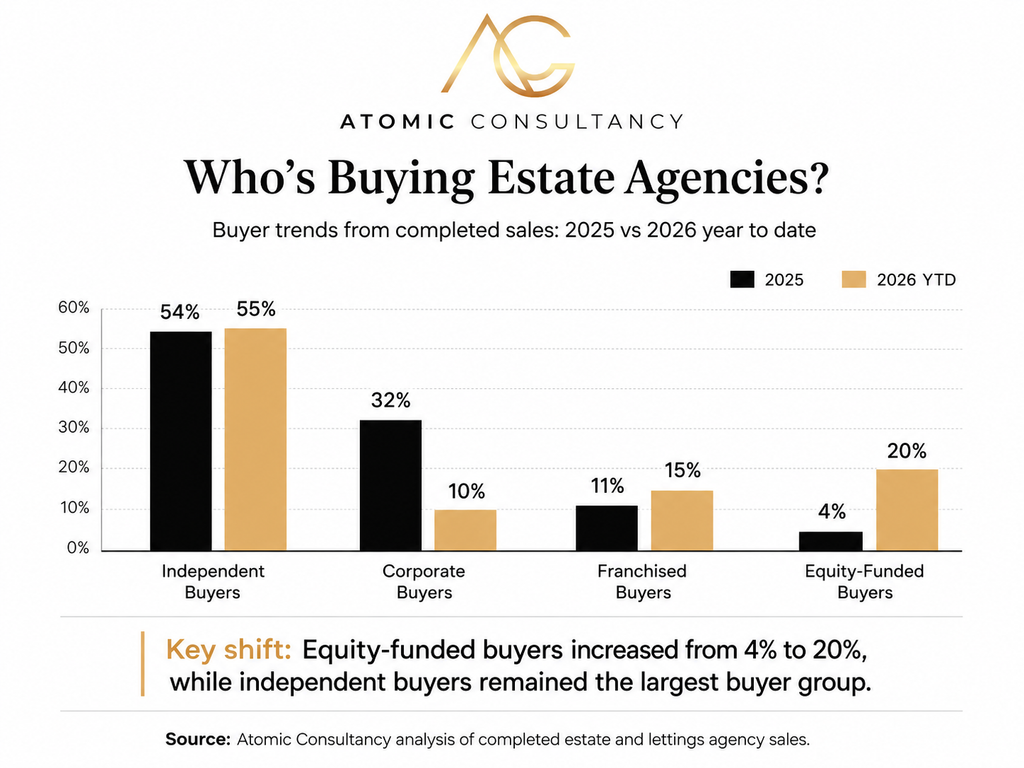
In 2025, the buyer split was:
- 54% Independent Buyers
- 4% Equity-Funded Buyers
- 11% Franchised Buyers
- 32% Corporate Buyers
in 2026 year-to-date, the split has changed to:
- 55% Independent Buyers
- 20% Equity-Funded Buyers
- 15% Franchised Buyers
- 10% Corporate Buyers
Independent buyers have remained remarkably consistent, moving only from 54% to 55%.
The most striking change is the rise in equity-funded buyers, from 4% to 20%.
Corporate buyers have moved in the opposite direction, from 32% to 10%, while franchised buyers have increased modestly.
This does not mean corporates have left the market. It suggests that those still acquiring may be applying tighter criteria and concentrating on opportunities that fit their strategy particularly well.
Overall, the market is being shaped by several buyer types rather than dominated by one. That creates choice for sellers, but it also makes careful positioning more important.
What These Shifts Mean for Sellers
The growth of equity-funded buyers is important because these acquirers often look at a business as part of a wider growth plan.
They may be interested in scale, recurring lettings income, operational efficiency and how easily an agency can be integrated into a larger group.
That means a seller cannot rely on broad claims about potential.
Buyers will want evidence!
They are likely to examine the managed portfolio, recurring revenue, team structure, systems, compliance, contracts, client retention and management information in detail.
Corporate buyers may ask many of the same questions, particularly around integration and the quality of financial and operational records.
With fewer corporates represented in the current data, the businesses that fit their requirements are likely to need to demonstrate that fit clearly.
This is where early preparation has real value.
A strong brand and healthy portfolio may attract attention, but clean records, clear reporting and well-organised information give buyers the confidence to move forward.
Atomic’s Exit Advantage programme is designed for owners who may be one to three years away from selling.
It helps them view the business through a buyer’s eyes, address weaknesses early and avoid trying to solve everything once a deal is already underway.
“Regardless of buyer type, our role is to make sure sellers are positioned in the strongest possible way before serious conversations begin. Every buyer will want confidence in the business, but equity-funded buyers often review opportunities at a more detailed and strategic level. They may need to present the opportunity to investors, funders or a board, so the quality of the data really matters. Clean records, clear management information and a well-prepared business can make a real difference to how confidently a buyer can move forward.”
Laura Cooper, Acquisitions Director at Atomic Consultancy
Independent Buyers Remain the Driving Force
Despite the growth of investment-backed acquirers, independent buyers still account for more than half of the market.
That consistency is significant.
These buyers may be looking to enter a neighbouring town, add a managed portfolio, strengthen their sales pipeline or acquire an experienced local team.
They often understand the practical value of an established agency in a way that goes beyond a spreadsheet.
For many owners, that matters.
A sale is not simply a financial transaction; it is the handover of a business they have built over many years.
Questions about staff, landlords, vendors, brand identity and local relationships can be just as important as price.
An independent buyer may therefore offer the right balance of commercial ambition and continuity.
The best buyer is not always the largest buyer; it is the one whose plans fit the business and the seller’s priorities.
Independent buyers still need clear information and confidence in what they are acquiring. The difference is often in how they interpret the opportunity and what they believe they can build from it.
What Recent Agency Sales Tell Us
The data also reflects what Atomic Consultancy is seeing in real transactions.
Recent sales involving businesses such as Paramount, Grange London and Keatons show that buyer appetite is coming from a range of directions.
Some buyers are pursuing recurring lettings income.
Others want geographic expansion, an experienced team or a well-run agency that can support a larger growth strategy.
The common thread is not simply the type of buyer. It is how clearly the opportunity is presented.
A business with a straightforward story, reliable information and well-organised records is easier for buyers to understand.
That helps create confidence, keeps conversations moving and reduces the chance of uncertainty slowing the process down.
What Should Agency Owners Take From This?
The acquisition market remains active, but the mix of buyers is changing.
Independent buyers remain the largest group, equity-funded buyers have become much more prominent, franchised buyers continue to contribute and corporates appear to be choosing their opportunities more carefully.
For owners, this means there is no single route to sale.
The right acquirer could be a nearby independent, a regional group, a franchise operator, a national corporate or an investment-backed buyer.
Each will view the agency differently, but all will need confidence in the business.
Sellers are in a stronger position when they understand how their agency may be perceived, present its strengths clearly and are ready for detailed questions once serious interest begins.
Thinking About Selling Your Estate or Lettings Agency?
Understanding who is buying is a useful starting point.
The more important question is how your own business would look to those buyers and whether it is ready for the scrutiny that comes with a serious sale process.
At Atomic Consultancy, we help owners understand the market, identify likely buyer types and prepare their business for sale.
For some, that means going to market now. For others, it means starting earlier through Exit Advantage and strengthening the business before buyers are approached.
Buyer appetite is still there.
The strongest outcomes are usually achieved by owners who understand the market early, prepare properly and find a buyer whose plans fit both the business and the people behind it.
If you are considering your options, a good place is to find out what your estate agency is worth, speak to Atomic Consultancy about how your business may be viewed by today’s buyers.