 ACQUISITION SERVICES SUPPLIER OF THE YEAR


If you have been thinking about selling your estate or lettings agency at some point in the next couple of years, the Budget 2026 BADR changes announced on 28 October have probably made that thought feel a little more urgent.
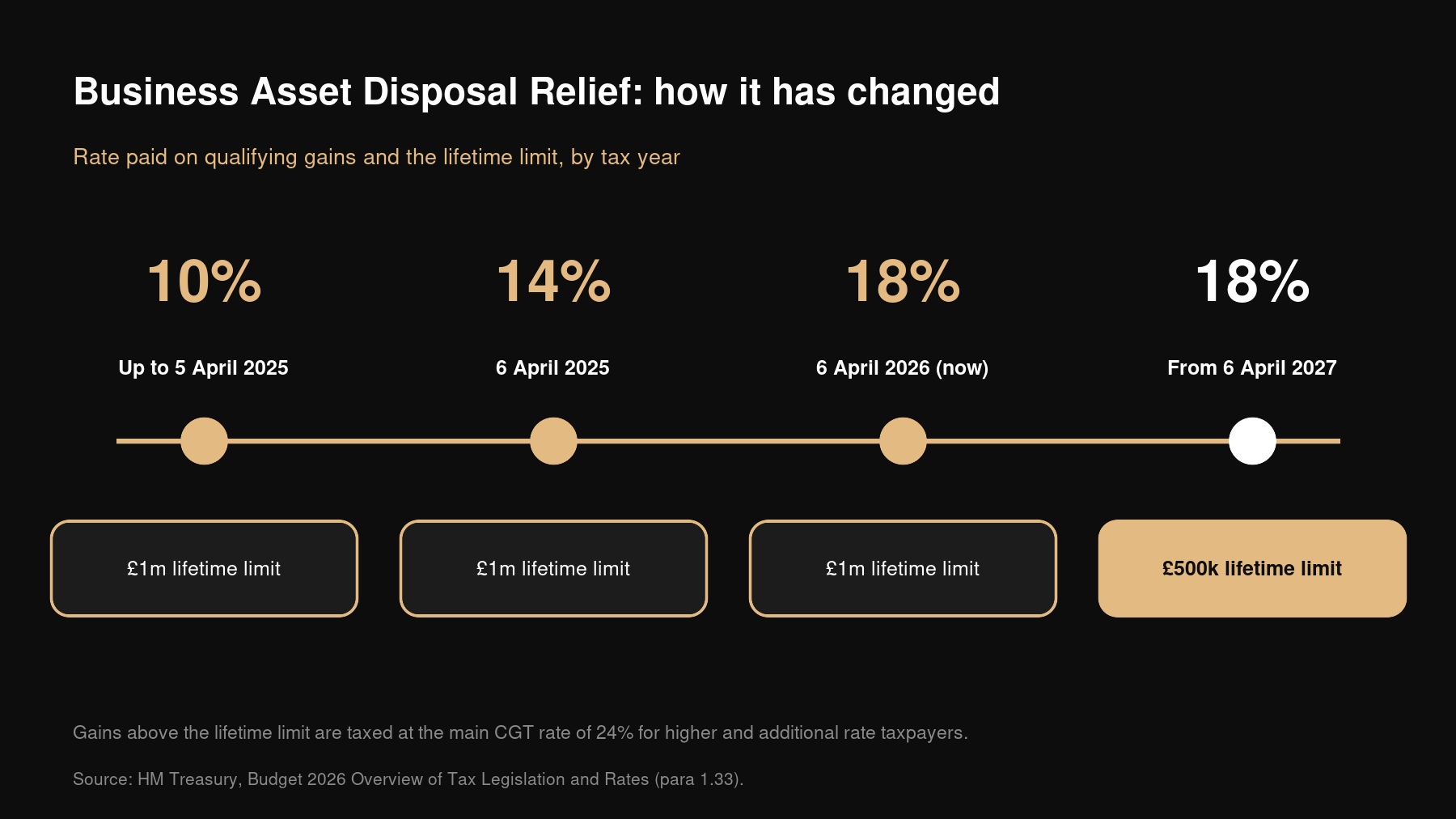
The headline for agency owners is a change to Business Asset Disposal Relief, better known as BADR. From 6 April 2027, the lifetime limit on gains that qualify for the relief halves from £1 million to £500,000. The rate itself stays at 18%.
It is not the dramatic change some owners feared in the weeks before the Budget. But for anyone with a sizeable stake in a successful agency, it could add up to £30,000 to their tax bill on a sale. That is per shareholder, so for a business with two or three owners the total can be a lot more.
There was plenty more in the Budget that touches the property market, from higher tax on landlords' rental income to a new equity loan scheme for first time buyers. Some of it is confirmed. Some of it has been announced but is still waiting on the detail. And some of what was talked about beforehand never happened at all.
In this guide we look at all of it through one lens. What does it mean if you are thinking of selling an agency, and what does it mean if you are looking to buy one?
Every Budget brings a flurry of calls from owners, and this one has been no different. The BADR change isn't the cliff edge some people were worried about, but for someone who has spent decades building a successful agency, £30,000 is real money. The important thing is not to panic. If a sale before April makes sense for you, there is still time to do it properly. If it doesn't, the right deal later will be worth far more than a rushed one now.
Lucy Noonan, Founder of Atomic Consultancy
Budget 2026 at a Glance for Agency Owners
- BADR: the lifetime limit falls from £1 million to £500,000 for disposals on or after 6 April 2027. The 18% rate is unchanged.
- Capital Gains Tax: the main rates stay at 18% and 24%, so gains above the BADR limit will be taxed at up to 24%.
- Contracts already in progress: special rules are planned for contracts entered into before 6 April 2027 that haven't completed by then. HMRC has not yet published the detail.
- Founders' Relief: a new 10% rate has been proposed for founders of fast growing companies, but the conditions mean few independent agencies are likely to qualify. It is still out to consultation.
- Landlords: tax on property income rises to 24%, 44% and 49% from April 2027, which matters for anyone selling or buying a lettings business.
- First time buyers: a new scheme called Your First Home offers a 20% equity loan on new build homes in England, with the first loans from April 2027.
- Stamp duty: no changes.
Budget 2026 BADR: What Has Actually Changed?
BADR reduces the Capital Gains Tax you pay when you sell all or part of a qualifying business. For most agency owners that means selling shares in their limited company, where they have held at least 5% of the shares and voting rights and been an employee or officer of the business for at least two years before the sale. The full qualifying conditions are set out on GOV.UK.
The relief has been tightening for a while. Until April 2025, qualifying gains were taxed at 10%. That rose to 14% for the 2025 to 2026 tax year and to 18% from April 2026, as announced in the October 2024 Budget. Throughout that time, the lifetime limit has stayed at £1 million.
This Budget leaves the rate alone and goes after the limit instead. According to the government's Overview of Tax Legislation and Rates, the cap falls to £500,000 for qualifying disposals on or after 6 April 2027. The change will be made through the Finance Bill 2026 to 27.
The government says three quarters of BADR claimants will still get relief on their entire gain. That is probably true across the economy as a whole, where many claims come from small businesses with modest gains. But agency owners who have built a business over 15, 20 or 30 years, particularly where one or two people own most of the shares, can easily sit in the other quarter.
What Could the New Limit Cost You?
The easiest way to see the impact is to look at the tax on a gain before and after the change. The examples below assume the seller hasn't used any BADR before and that the gain falls in the higher rate band. They ignore the £3,000 annual exempt amount, costs and any other reliefs, so treat them as a guide only.
| Gain per shareholder | Disposal before 6 April 2027 | Disposal on or after 6 April 2027 | Extra tax |
|---|---|---|---|
| £250,000 | £45,000 | £45,000 | None |
| £500,000 | £90,000 | £90,000 | None |
| £750,000 | £135,000 | £150,000 | £15,000 |
| £1,000,000 | £180,000 | £210,000 | £30,000 |
| £1,500,000 | £300,000 | £330,000 | £30,000 |
| £2,000,000 | £420,000 | £450,000 | £30,000 |
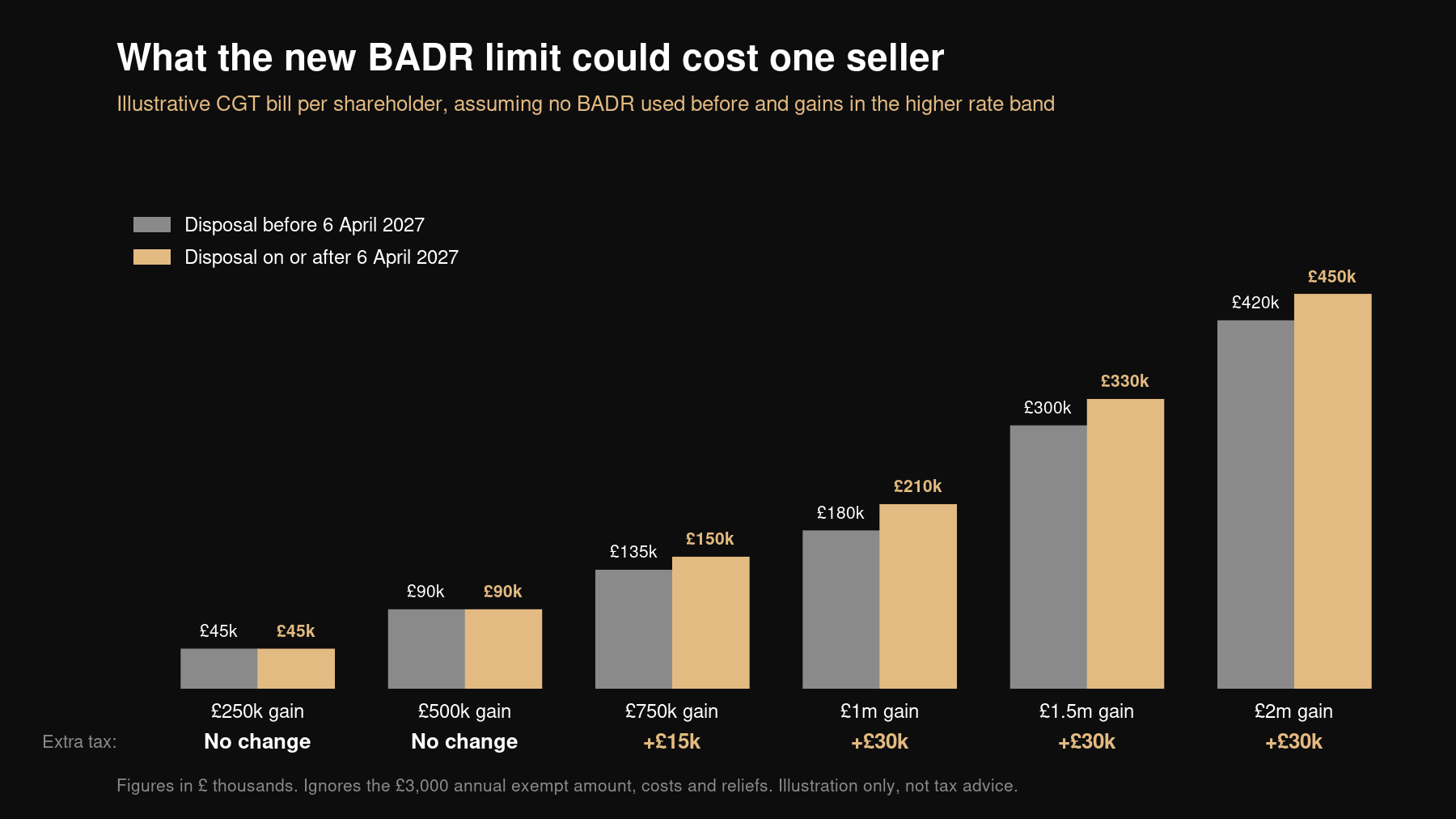
A few things stand out. If your share of the gain is £500,000 or less, nothing changes. Above that, the extra tax climbs until it reaches a maximum of £30,000 at a gain of £1 million, and stays there. That is because the only difference is the 6% gap between the 18% BADR rate and the 24% main rate, applied to the £500,000 of relief that disappears.
The limit applies to each person, not each business. So where two directors each own half of an agency and each makes a gain of £1 million, the combined extra tax would be £60,000.
It is also a lifetime limit. If you have claimed BADR before, perhaps when you sold an earlier business, a branch or a lettings book, you may have less headroom than you think. It is worth checking with your accountant now rather than finding out halfway through a deal.
Why the Date You Exchange Matters More Than Completion
This is the part that catches people out. For Capital Gains Tax, the date of disposal on most sales is the date the contract is made, not the date the deal completes and the money arrives. Where a contract is conditional, for example on regulatory approval or a landlord consent, the date is usually when that condition is met.
The Budget documents say there will be special provisions for contracts entered into before 6 April 2027 that haven't been completed, and for some share reorganisations and share for share exchanges. What they don't yet say is exactly how those rules will work. HMRC is expected to publish more detail, and some commentators, including Business Sale Report, are advising owners to take advice before signing any transaction documents.
Until that detail is out, nobody should assume that signing something in late March 2027 will automatically lock in the old limit. We will update this article once the rules are confirmed.
Deal structure matters too. Many agency sales include deferred consideration, retention payments linked to landlords staying on, or an earn out. How and when those payments are taxed depends on how the deal is put together, and that is a conversation to have with your tax adviser early, not at the end.
The deals that complete quickly are the ones where the groundwork has already been done. If your accounts, landlord agreements and compliance records are in good order, five months is workable. If they're not, April can come round very fast, and buyers can usually tell when a seller is up against the clock.
Laura Cooper, Acquisitions Director at Atomic Consultancy
Is Selling Before April 2027 Realistic?
For a well prepared agency, it can be. When Keatons in East London went to market at the start of 2025, the aim was to complete before that year's BADR rate rise in April. Atomic was instructed in early January, the business launched at the end of the month, an offer was agreed at the beginning of March and the sale completed before the deadline. Kye Wheatley talked about the experience on episode two of the Boom podcast.
That kind of timetable depends on a business being ready. Clean, up to date accounts. A clear picture of the lettings portfolio. Compliance records that stand up to scrutiny. A team that can keep running the business while the owner is in meetings with buyers and solicitors.
It also depends on being realistic about what the tax saving is worth. The most anyone will save by beating the deadline is £30,000. A rushed sale that knocks £100,000 off the price, or leaves you with weaker terms on deferred payments, is not a good trade. We cover this in more detail in our article on why time can be one of the most valuable assets in an agency sale.
If you are already close to ready, now is the time to talk. If you are not, the better move may be to plan properly for a sale in 2027 or 2028 and focus on building value. That is exactly what our Exit Advantage programme is designed for.
Founders' Relief: Will It Help Agency Owners?
Alongside the BADR cut, the Chancellor announced a brand new relief for founders. It would tax qualifying gains at 10% on up to £10 million over a lifetime, for disposals from 6 April 2027.
On paper that sounds generous. In practice, the proposed conditions are aimed at fast growing, innovative companies. Based on the consultation as it stands, as summarised by Forsters, the business would need:
- Turnover of at least £10 million and at least 15 full time employees in the year before the sale.
- To pass two of three growth tests, such as 25% average annual growth in turnover or headcount over three years, or at least £1.5 million spent on qualifying research and development.
- A founder who held at least 25% of the shares from the start and has held them for at least five years.
Very few independent estate or lettings agencies will meet those tests. Any BADR you claim also reduces the Founders' Relief you could get later. The consultation closes on 30 November 2026, so the rules could still change, but for now we would not plan a sale around it.
Other Budget Changes That Affect Agency Sellers
BADR gets the headlines, but buyers value an agency on its profits and its future income. Several other measures in the Budget feed straight into that.
Higher Tax on Landlords' Rental Income
Last year's Budget introduced separate income tax rates for property income from April 2027. This Budget has gone further, adding another two percentage points. From 6 April 2027, landlords will pay 24%, 44% or 49% on their rental profits, depending on their tax band. That is four points above the rates they pay today.
For lettings agencies, this sits on top of the changes we looked at in last year's article on the Renters' Rights Act and the 2025 Budget. Some smaller or accidental landlords will decide it is time to sell, which can bring sales instructions in the short term but chip away at managed portfolios over time. Propertymark described the rise as a further disincentive to potential landlords and warned it could push rents up.
For sellers, this makes landlord retention and the make up of your portfolio even more important. A lettings book built on professional landlords with several properties each will hold its value far better than one that depends on lots of single property owners.
Wage Costs
The National Living Wage will rise by 3.9% to £13.21 an hour from 1 April 2027. There was no increase to the headline rates of National Insurance. For agencies with junior negotiators, administrators and lettings staff, the wage rise will add to costs, and because many agencies are valued on a multiple of profit, any squeeze on margins has a knock on effect on value.
Business Rates
From April 2027, full Small Business Rates Relief will apply to qualifying retail, hospitality and leisure properties with a rateable value of up to £18,000, up from £12,000, tapering away up to £21,000. Whether a high street agency counts as retail for these purposes will depend on the final definitions. Propertymark has asked the government to make sure property businesses are considered, so this is one to check with your rates adviser once the detail is published.
The Housing Market Outlook
The Office for Budget Responsibility's latest forecasts, reported by Mortgage Solutions, point to steady rather than spectacular conditions:
- House prices are expected to grow by around 2% in 2026 and 2.5% in 2027.
- Housing transactions are forecast to rise from around 1.2 million in 2026 to around 1.3 million by 2031, although that is 4% lower than the March forecast.
- The average interest rate on outstanding mortgages is expected to climb from about 4% to around 5% by 2031 as borrowers come off older, cheaper fixes.
- Inflation is forecast to peak at 3.8% in early 2027 before returning to the 2% target in 2028, according to the Budget 2026 document.
For agency valuations, a market like this tends to favour businesses with strong recurring income. Sales commission rises and falls with transactions. Lettings and management fees keep coming in.
The High Value Council Tax Surcharge
From April 2028, owners of homes in England worth £2 million or more will pay an annual surcharge on top of their council tax, from £2,500 a year up to £7,500 a year for homes worth over £5 million. The threshold stayed at £2 million, despite talk before the Budget that it could drop to £1.5 million. Draft valuation bands are due in autumn 2027.
This mainly affects agencies in prime London and parts of the South East. Buyers looking at agencies in those markets may ask how much of the sales income comes from homes close to or above the threshold.
First Time Buyers: What Was Actually Announced?
There has been a lot of talk in recent months about a new right to buy style deal for first time buyers. What the Budget actually confirmed is a new scheme called Your First Home, plus some changes to the Lifetime ISA.
Your First Home
According to the details published on Budget day, Your First Home will work like this:
- First time buyers put down a deposit of between 2.5% and 15%.
- The government lends up to 20% of the price as an equity loan, interest free for five years. The rate is 1.5% in year six and 3% from year seven.
- Household income is capped at £110,000 outside London and £140,000 in London.
- Prices are capped at £650,000 in inner London and £500,000 in outer London. Caps for the rest of England will be based on local median prices and are still to be published.
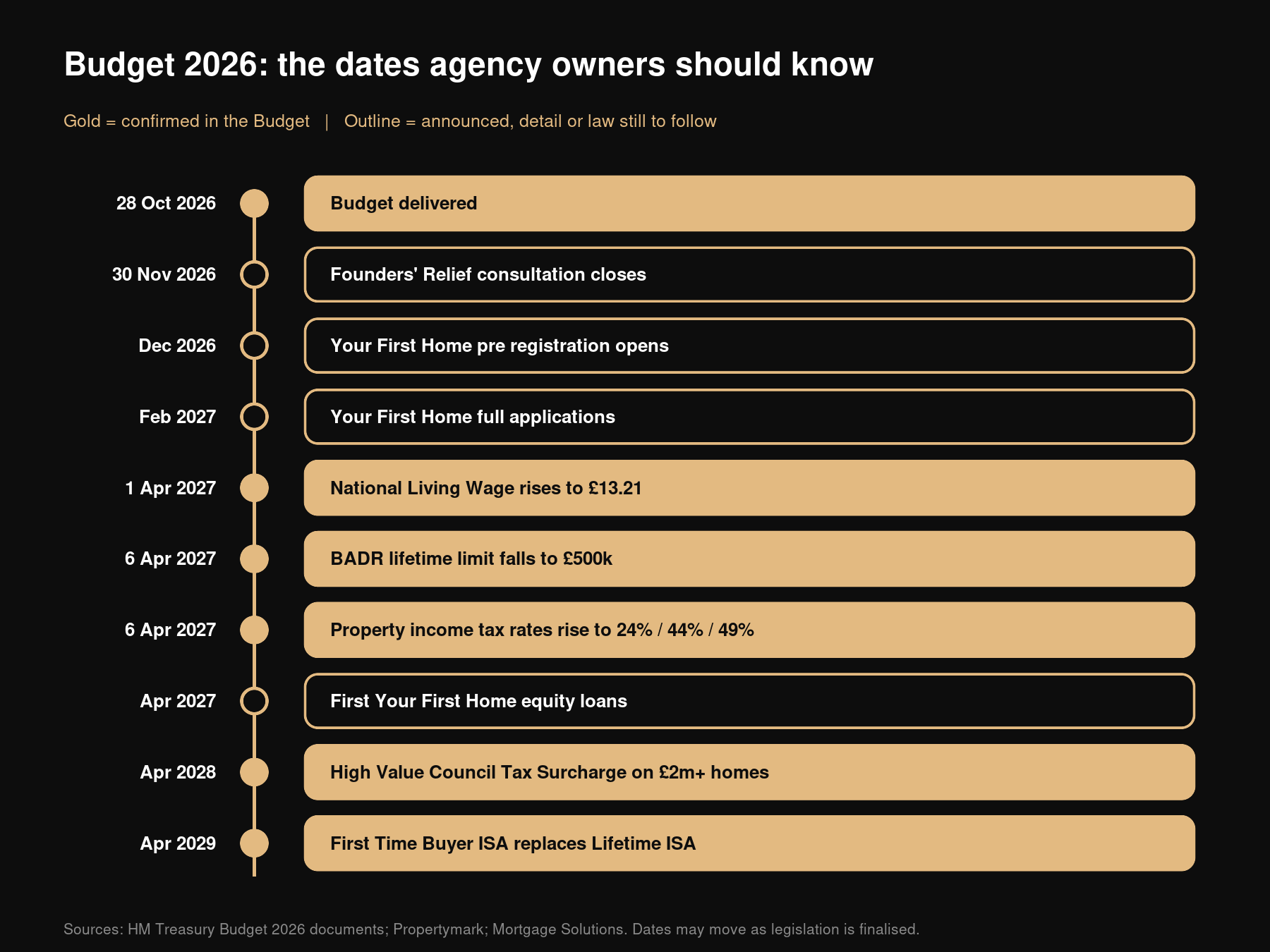
- Pre registration opens by the end of December 2026, full applications from February 2027 and the first loans from April 2027.
- £4.7 billion has been set aside, with the government expecting to help around 70,000 households.
The scheme is focused on new build homes, which is why Propertymark said support needs to go beyond buyers of new build properties. The OBR expects only a marginal effect on housing supply and a slight upward nudge to prices.
Lifetime ISA and the New First Time Buyer ISA
From 29 October 2026, the penalty for using a Lifetime ISA to buy a first home costing more than £450,000 has been cut to 20%. In simple terms, buyers in higher priced areas now lose the government bonus rather than some of their own savings as well. From April 2029, a new First Time Buyer ISA will replace the Lifetime ISA for new savers, with up to £4,000 a year, a 25% bonus capped at £20,000 and a £450,000 price cap.
What It Means for Agencies
For most high street agencies selling second hand homes, the direct impact will be limited. Agencies with a busy new homes department could see more activity. There is also a chance that some first time buyers hold off until the scheme opens in the spring, which could slow activity at the lower end of the market for a few months. Stamp duty relief for first time buyers stays as it is, with no tax on the first £300,000 for homes up to £500,000.
Anything that helps first time buyers onto the ladder is good for the market as a whole. But this scheme is aimed at new build homes, so for most high street agencies the bigger story is still mortgage rates and confidence. That's what drives transaction numbers, and transaction numbers drive sales income.
Lucy Noonan, Founder of Atomic Consultancy
What the Budget Means If You Are Buying an Agency
If you are an investor or an established group looking to grow through acquisition, the next few months could be busy. Here is what we expect buyers to be thinking about.
- More sellers, sooner. Some owners who were planning to sell in 2027 or 2028 will now look at bringing that forward. Buyers who can move quickly, with funding and legal support ready, will be in a strong position.
- Pressure on timetables. Sellers racing the April deadline will want certainty. Expect more focus on exchange dates, and on how much is paid at completion compared with later.
- Closer scrutiny of lettings books. The landlord tax rise makes landlord retention a bigger question in due diligence. Buyers will want to understand portfolio mix, how many single property landlords there are and how long landlords have stayed.
- Higher running costs. The National Living Wage increase needs to be built into forecasts, alongside the higher employer National Insurance costs that came in during 2025.
- Prime market exposure. In London and the South East, buyers may look at how much of a target's sales income comes from homes affected by the new council tax surcharge.
- Keeping key people. From April 2027, the Company Share Option Plan will be renamed EMI2 and the option limit per employee doubles from £60,000 to £120,000. That gives buyers more room to incentivise branch managers and senior staff after a deal.
We talked about who is buying agencies at the moment in our recent article on new trends every seller should know. If you are looking to acquire, our buying service supports you from offer through to completion.
Buyers are already asking more questions about lettings portfolios, and the landlord tax rise will only add to that. They want to know how many landlords you have, how many properties each one owns and how long they have been with you. A spread of loyal, professional landlords is worth a lot more than a book that relies on a handful of accidental ones.
Laura Cooper, Acquisitions Director at Atomic Consultancy
Fact or Fiction? Separating the Budget From the Speculation
In the run up to any Budget there is no shortage of predictions. Here is how some of the talk compares with what was actually announced, and what is still to be confirmed.
| What was talked about | What actually happened | Status |
|---|---|---|
| BADR could be scrapped altogether | BADR stays at 18%, but the lifetime limit halves to £500,000 from 6 April 2027 | Announced, law to follow |
| Capital Gains Tax rates brought in line with income tax | No change. The main rates stay at 18% and 24% | Confirmed |
| Signing before April 2027 locks in the old BADR limit | Special rules are promised for contracts made before 6 April 2027, but the detail has not been published | Not yet known |
| A new low tax rate for business founders | A 10% Founders' Relief on up to £10 million, aimed at fast growing companies with £10m+ turnover | Out to consultation |
| The mansion tax threshold cut to £1.5 million | The surcharge applies to homes worth £2 million or more from April 2028 | Confirmed |
| A stamp duty overhaul | No changes to stamp duty | Confirmed |
| A new deal for first time buyers on all homes | Your First Home focuses on new build homes, with price caps outside London still to come | Partly confirmed |
| Further tax rises for landlords | Property income tax rises to 24%, 44% and 49% from April 2027 | Confirmed |
Anything marked as announced or out to consultation can still change before it becomes law. The Finance Bill and HMRC's technical guidance will fill in the gaps over the coming weeks and months.
Budget 2026: The Key Dates
What Should Agency Owners Do Now?
Whether you are thinking of selling next spring or in a few years' time, there are some sensible steps to take now.
- Find out where you stand. Check your shareholding, whether you have claimed BADR before and roughly what your gain might be. Your accountant can help with this.
- Get a realistic idea of value. Our free value estimator gives you a starting point, and a full valuation gives you a figure you can plan around.
- Decide whether April 2027 works for you. Be honest about how ready the business is. Accounts, landlord agreements, compliance records and staff contracts all need to be in order.
- Don't let tax drive the whole decision. A better price, stronger terms or the right buyer can easily outweigh a £30,000 tax saving.
- If you're not ready, plan properly. A six to twelve month programme like Exit Advantage can help you build value and sell on your own terms.
- Keep an eye on the detail. The rules on contracts that straddle 6 April 2027 are still to come. Take advice before you sign anything.
Final Thoughts
The Budget 2026 BADR changes are not the disaster some agency owners feared, but they do change the sums for anyone with a large stake in a successful business. The BADR limit is halving, the tax saving for selling before April 2027 is real, and the wider measures on landlords, wages and housing will all shape how buyers value agencies over the next few years.
The owners who come out best will be the ones who look at their own position early, take good advice and make a decision that is right for them, not one forced by a deadline.
If you would like to talk through what the Budget means for your agency, we're always happy to have a confidential, no obligation conversation. You can find out more about selling your agency or get in touch with the team.
This article is for general information only and is based on the Budget documents published on 28 October 2026. It is not tax or legal advice. Tax treatment depends on your personal circumstances, and some measures are still subject to consultation and legislation. Always speak to a qualified tax adviser before making decisions about a sale.